What Happens After Inspiration? Why the Feeling Fades and What To Do Instead

Author | Siddharth Anantharam, Cofounder Unlimits
You finished the book at midnight and stayed up another hour thinking about all the ways your life was about to change.
You left the seminar with pages of notes and a feeling in your chest that something had shifted.
You wrote the resolution. This year, you meant it.
Three weeks later, nothing had changed. Maybe less than nothing, because now you also carry the memory of having felt that way and not followed through.
This is one of the most common human experiences. It has a name in psychology: the intention-behaviour gap. The distance between deciding to do something and actually doing it.
Why inspiration fades.
Inspiration is an emotional state. Like all emotional states, it is temporary. The biology that produces it cannot sustain it indefinitely. The burst of motivation you feel after a powerful talk or a book that lands exactly right is real. It is also designed to fade.
This is not a failure of willpower. It is physiology.
The problem is that most people treat inspiration as the beginning of change. It is not. It is a signal. What you do in the days immediately after the signal determines whether anything actually changes.
The action window.
Research on behaviour change consistently shows a short window after inspiration or intention-setting where the probability of follow-through is highest. This window is roughly 24 to 72 hours.
If you take a concrete action in that window, even a small one, the likelihood that you continue increases significantly. If you do not, the emotional state fades and the original pattern comes back.
This is why the book that changed your life did not change your life. Not because the ideas were wrong. Because you closed it, went to sleep, and woke up to the same Tuesday.
What books, talks, and seminars actually give you.
Direction. Clarity. Occasionally, permission. These are valuable. But they are inputs, not outcomes.
The person who reads ten books on courage is not necessarily braver than the person who read one and then did something uncomfortable. Information and inspiration are not the same as practice. Practice is what changes the pattern.
Practice requires starting, stopping, and starting again. It requires a structure that survives the days when you do not feel inspired at all.
The shift that actually works.
The people who sustain change after inspiration tend to do one thing differently. They do not wait for the next wave of motivation. They build a small daily practice that keeps them moving whether they feel ready or not.
Not a 30-step morning routine. Not a complete life overhaul the week after the seminar. One consistent action that connects today’s choices to the version of themselves they decided they wanted to become.
That is what the research supports. Small, consistent, identity-connected actions compound over time. Inspiration is the reason you start. Practice is the reason you arrive.
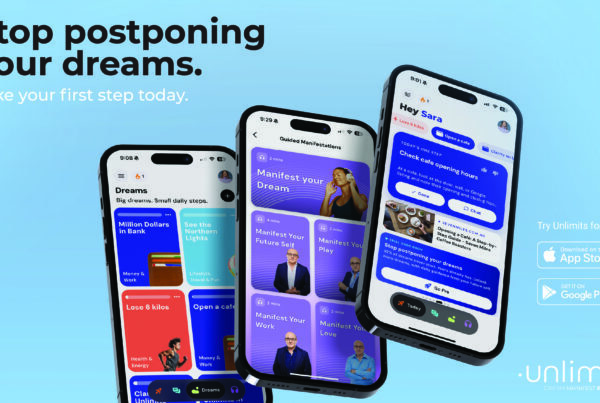
Unlimits is built around this gap. Not to keep you inspired. To keep you moving on the days when inspiration is nowhere nearby.
Define the version of yourself you are working toward. Take a step today. Come back tomorrow.
Most dreams don’t fail. They get postponed. One step at a time is how they stop being postponed.
Download Unlimits today.